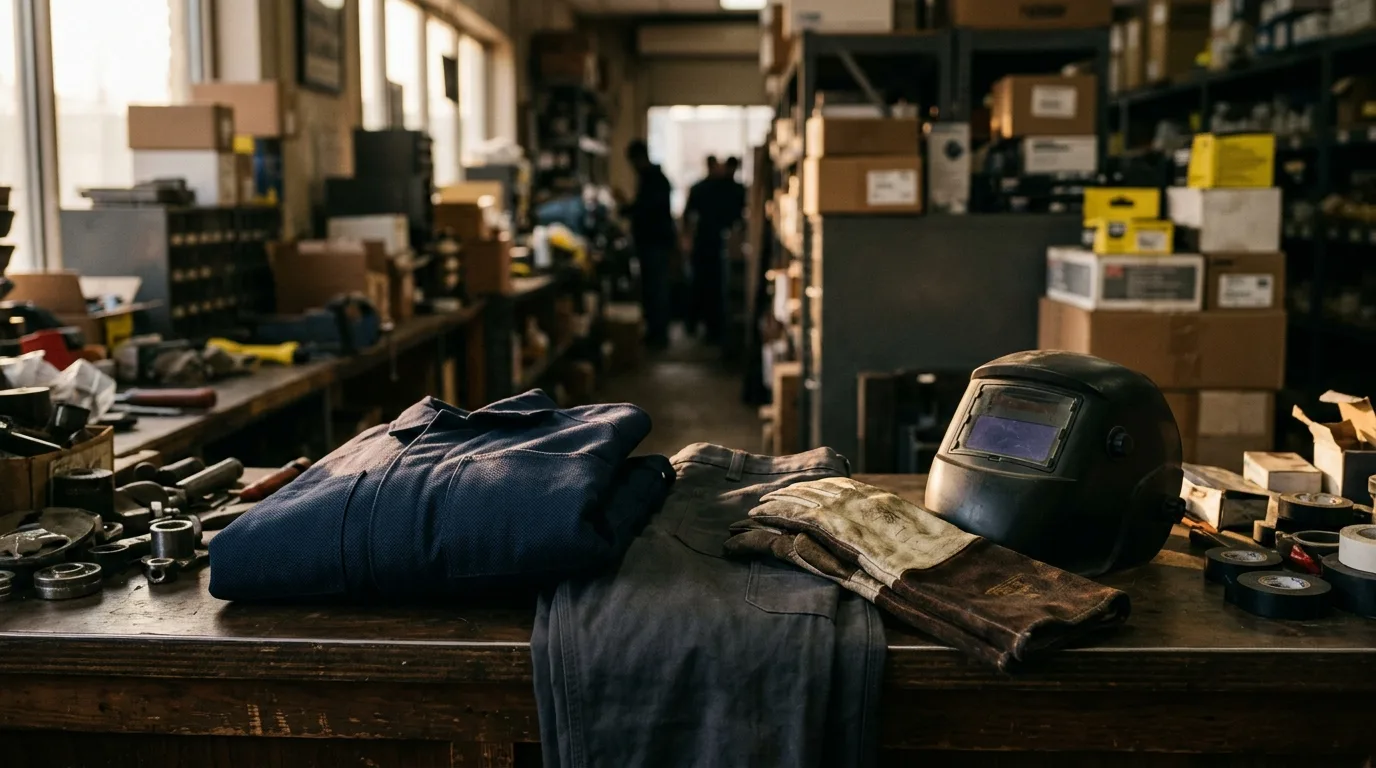
Welder FR workwear in Staten Island is the most code-driven kit on any jobsite, and the code is the part most supply houses get wrong. NFPA 2112 for flash-fire protection, ASTM F1506 for arc-flash, plus the unwritten rule that what you wear under the FR matters as much as the FR jacket itself. Quazi Supply at 519 Port Richmond Avenue stocks for welders specifically. Eleven to eight, seven days a week.
Start with the rule that gets people hurt. Cotton over synthetic. Always. A polyester t-shirt under a flame-resistant jacket will melt to your skin in a flash event because the FR jacket is not designed to be your last layer of defense — it is designed to self-extinguish, and the cotton or wool layer underneath is what stays intact when the FR layer is doing its job. Synthetic baselayers under FR are the leading cause of severe burn injuries in welders who were otherwise wearing the right gear. Cotton t-shirt, cotton long-sleeve, FR baselayer if you have one. Never polyester or nylon.
FR jacket. Heavy. NFPA 2112-certified for flash-fire and ASTM F1506-rated for arc-flash, with an arc rating (ATPV) appropriate to the work. Carhartt FR Force jacket, Carhartt FR Heavyweight Quilt-Lined jacket for cold-weather welding. The jacket is the headline piece because it covers the torso and arms — the two parts most exposed to spatter, slag, and flash. Eight-ounce or heavier FR fabric for serious work; the lighter four-ounce FR is for tasks like grinding and torch-cutting where the heat exposure is lower.
FR pants. Carhartt FR Force jeans, Carhartt FR Canvas pants. NFPA 2112-certified. The reason FR pants are a separate purchase from regular Carhartts is that a welding spark or a piece of slag will burn through regular cotton in seconds, and the FR-treated fabric self-extinguishes. Reinforced seat and knee. We carry 28 to 50 waist.
FR baselayer. The most-skipped piece of welder PPE. A long-sleeve FR shirt under the FR jacket, an FR henley, an FR midweight cotton shirt. Carhartt FR Midweight long-sleeve. The reason this matters is that the moment you take the jacket off — for a break, in a hot mechanical room — your arms and torso are protected only by what you have underneath. Synthetic shirt, you are exposed; cotton, you are okay; FR cotton, you are correct. We carry the full FR baselayer line in M to 4XL.
Welding hood. We carry the consumer-grade and mid-tier auto-darkening hoods — Lincoln, Miller-style aftermarket, the Jackson auto-dark. For top-tier hoods (Optrel, top-end Miller), we point welders to the welding-specific suppliers. The hoods we stock cover the everyday welder — solar-powered auto-darkening with adjustable shade, replaceable lens covers, and a comfortable headband. Replacement clear cover lenses we sell by the ten-pack.
Welding gloves. Long-gauntlet leather. Twelve to fourteen inches up the forearm for stick and MIG, slimmer for TIG so you can feel the rod. We carry the heavy split-cowhide gauntlet gloves and the lighter goatskin TIG glove. Two pairs in the kit minimum because they wear faster than any other welder PPE. Kingston, Eurbak, and the Carhartt welding glove all stocked.
Boots. Heavy leather. Welding spatter on a synthetic boot will melt through; on leather it leaves a mark and that is it. Smooth leather, not pebbled or oiled, because a smooth leather sheds spatter where a textured leather catches it. Steel toe is the call — heavy plate, heavy stock. EH rating for any electrical-adjacent work, which most welding is. Eight-inch shaft minimum to keep spatter out of the top. Red Wing 2406, Carhartt CMW8195 in the welder-specific spec, Wolverine Floorhand in heavy leather. We carry the welder-specific boots in stock.
"Synthetic baselayers under FR are the leading cause of severe burn injuries in welders who were otherwise wearing the right gear — cotton over synthetic, always."
Welding cap. Cotton. Patterned bandana-style. The cap goes under the hood and protects your scalp from spatter that comes around the edge of the helmet. We carry the standard six-panel welder caps in plain colors and patterns, around eight to twelve dollars.
Apron. Heavy split-cowhide bib apron for any heavy-spatter work. Sleeves to match. The apron-and-sleeves combo is the right call for any heavy stick work, fab-shop work, or out-of-position welding where slag falls down the front. We stock the standard apron and the welder's leather sleeves.
Eye protection underneath the hood. Z87.1 safety glasses with side shields, worn under the welding hood. The hood is the primary eye protection during the arc; the safety glasses are for the moments you flip the hood up — slag chip, grinding wheel, the wire wheel cleaning the bead. Two pairs in the kit.
Hearing protection. Earplugs for any cutting, grinding, or torch work. Welding itself is quieter than a lot of trade work, but the prep — grinding, cutting, fitting — is loud.
Hard hat with welding-helmet adapter. For overhead welding on commercial sites, a hard hat with the slot-mount welding hood is the right setup. Type II Class E hard hat with a Lincoln or Jackson slide-in welding hood.
Custom printing on the building. Shop name on FR jackets and FR pants is a tricky proposition because traditional ink screen prints can compromise the FR rating; we use FR-rated thread for embroidery and FR-rated ink for any garments where the FR certification is critical. We will walk you through the options at the counter. Apply for a fleet account at /services/fleet-and-crew-accounts/apply if your shop wants net-30 and volume pricing on five units or more.
Jobsite delivery across the five boroughs. Same-day across Staten Island. If a welder on a Brooklyn site burned a hole through a glove and is down to one pair, call the counter — on the truck inside an hour.
519 Port Richmond Ave. Eleven to eight, seven days a week. Open Sundays. Cotton under the jacket, every time.