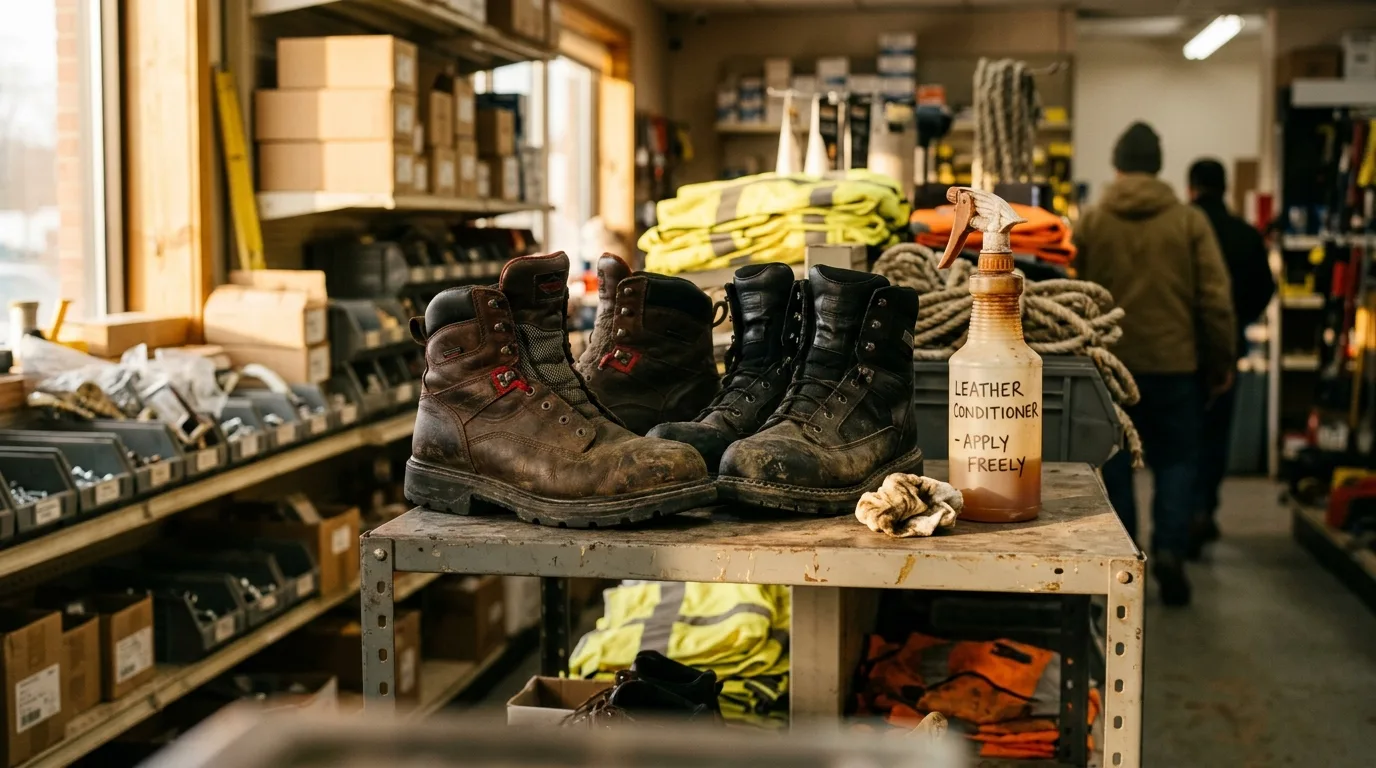
Waterproof work boots in Staten Island are on the wall at Quazi Supply, 519 Port Richmond Avenue. We carry membrane-lined and treated-leather waterproof builds from Red Wing, Irish Setter, Timberland Pro, Labo, Wolverine, and Thorogood — full size run, half sizes included, wide widths in stock. Open 11 to 8, seven days. Same-day pickup and jobsite delivery available across the boroughs.
Waterproofing in a work boot comes down to two approaches: a synthetic membrane sealed inside the boot, or a leather upper treated to repel water at the surface. Both work. They fail in different ways and last for different lengths of time, and the right choice depends on what you do and how you take care of your gear.
Membrane waterproofing — Gore-Tex, Timberland Pro's TimberDry, Wolverine's UltraSpring — is the standard in modern boots. A breathable, waterproof membrane is sandwiched between the leather upper and the lining. Water can't get through the membrane, but water vapor (sweat) can escape outward. The advantage: the boot is waterproof on day one and stays that way without conditioning. Membranes are also waterproof in standing water and sustained rain — water can't soak in through the leather even if the leather wets out.
The disadvantage: membranes wear out. Constant flexing at the toe and ankle eventually creates micro-cracks in the membrane, usually after 18 to 36 months of daily wear. Once the membrane fails, the boot is no longer waterproof and there's no way to rebuild it. The leather around the membrane traps moisture against your foot. Most membrane boots get replaced rather than repaired when waterproofing fails.
Treated leather waterproofing — full-grain leather conditioned with mink oil, beeswax, or proprietary leather treatment — is the heritage approach. Red Wing 2406 and Irish Setter Ramsey use this method. The leather itself is waterproofed, and as long as you condition it every few months, it stays waterproof for the life of the boot. The advantage: the boot can be rebuilt indefinitely. New soles, new welt, new conditioning — and the same boot keeps going for ten or fifteen years.
The disadvantage: treated leather requires upkeep. If you don't condition it, the waterproofing wears out in three to six months and you're walking in wet socks. Treated leather is also less waterproof than a membrane in standing water — sustained immersion (wading through a flooded basement, for example) will eventually saturate the leather no matter how recently you conditioned it.
On the wall, brand by brand for waterproof.
Red Wing and Irish Setter are the treated-leather kings. The Red Wing 2406 is the work boot that built the brand — full-grain leather, Goodyear welt, conditioned with Red Wing's own boot oil. The Irish Setter Ramsey is the more affordable Red Wing-family option at around $200. Both are made to be conditioned and resoled. Welders, foremen, and lifelong tradesmen pick these.
"Don't put leather boots near a heater to dry. Heat dries the leather faster than the conditioning oils can survive, and the leather cracks."
Timberland Pro Boondock waterproof is the membrane workhorse. TimberDry membrane, around $230, ASTM F2413 rated, anti-fatigue midsole. Most popular waterproof boot in the store by volume. Goes to framers, masons, and demo crews working through wet seasons.
Labo waterproof is the value-tier waterproof option. Around $130 to $170. Membrane waterproofing in a lighter, more affordable build. Goes to homeowners doing exterior projects, weekend handymen, and crews replacing damaged boots mid-season without wanting to spend $230.
Wolverine Floorhand waterproof and Overpass waterproof are the middle tier. UltraSpring membrane, around $180 to $220. Loyal following among guys who've worn through a Timberland Pro and want something different.
Thorogood Infinity FD waterproof is the American-made membrane option. Around $260. Resoleable Goodyear welt construction combined with membrane waterproofing — gives you the rebuildable advantage of treated leather with the day-one performance of a membrane.
Job sites that demand waterproof. Excavation and foundation work — standing in mud and water all day. Plumbing — same. Roofing in spring and fall — wet shingles, dew, drainage. Concrete pours — wet concrete eats through unprotected leather and chemically damages it on top of the moisture. Snow removal and winter exterior work — slush soaks through non-waterproof boots in twenty minutes. Demolition in older buildings — water-damaged structures and broken plumbing mean wet feet without waterproofing.
Conditioning treated leather. If you bought Red Wing or Irish Setter, you need their conditioning oil — we sell it. Apply with a clean rag every six to eight weeks of daily wear, more often if the boots get fully soaked. Don't use mink oil on a boot built with treated chrome-tanned leather (most modern Red Wings) — it darkens the leather permanently and can soften the structure. Use the manufacturer's recommended conditioner. Read the tag.
Drying wet boots. Whether your boots are membrane or treated leather, drying matters. Stuff them with newspaper or use a boot dryer (we sell those too). Don't put leather boots near a heater, radiator, or in direct sunlight to dry — heat dries the leather faster than the conditioning oils can survive, and the leather cracks. Air dry overnight.
Sizing for waterproof boots. Most run true to size, but membrane-lined boots feel slightly tighter than non-membrane versions because the membrane and lining take up volume. If you're replacing a membrane boot with a different membrane brand, you may need to size up a half. Try them on with the socks you actually wear. Brannock device is on the floor.
We're at 519 Port Richmond Avenue, Staten Island. Open 11 to 8, every day. Boot wall is in the back. If you're outfitting a crew that needs waterproof boots in volume — five or more pairs — we run fleet and crew accounts with net-30 terms and jobsite delivery.