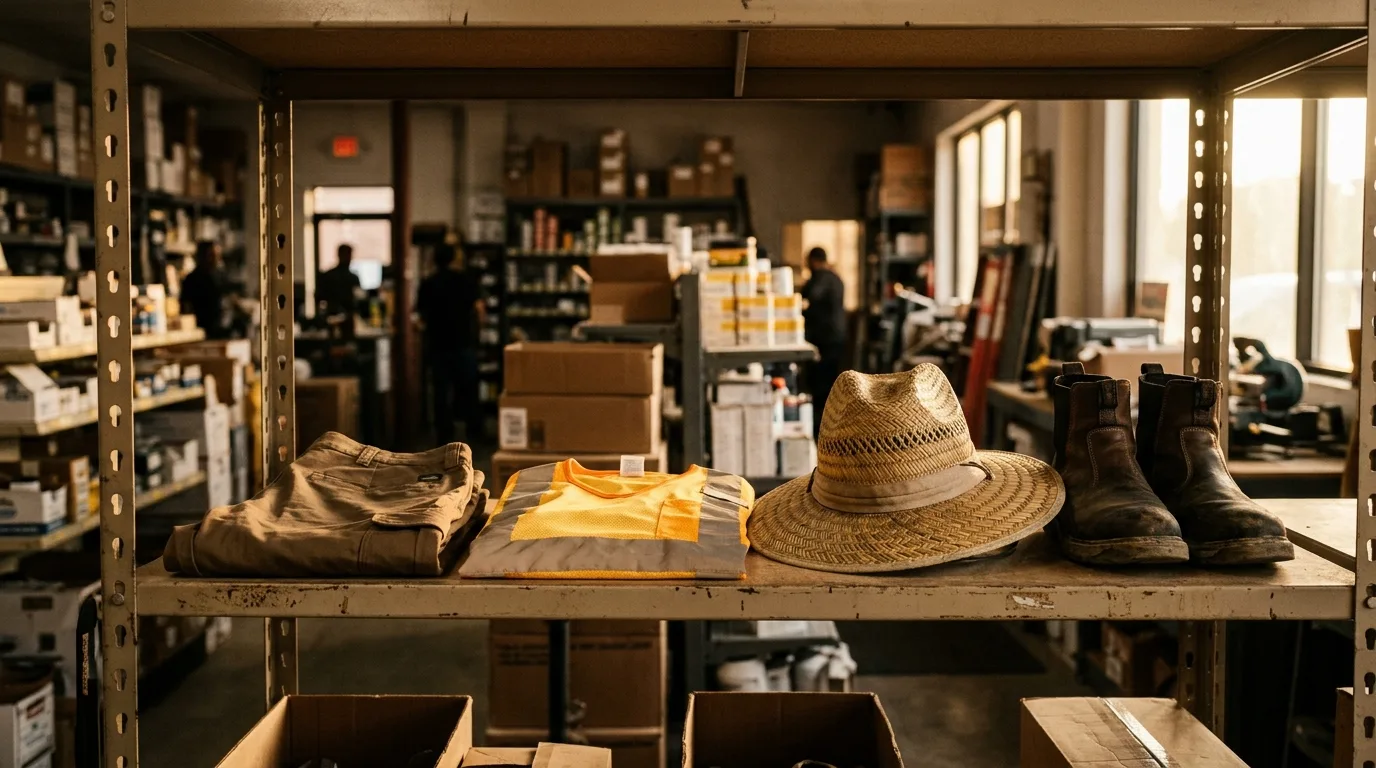
Roofer gear in Staten Island is a particular list, and it does not look like the kit a carpenter or an electrician walks in with. We have outfitted enough roofing crews out of 519 Port Richmond Avenue to know what the day actually requires. Boots that do not slip on shingles, pants that breathe through a July roof deck, hi-vis and a real hat for the sun, and the small things that keep you from leaving the deck in an ambulance. Open eleven to eight, seven days a week.
Boots come first and the rule is different from every other trade. You want a flat outsole — wedge or shaved-down lug — not a deep aggressive tread. Deep treads pick up granules and grit from a shingle roof and turn into roller bearings on the next pitch you climb. Cougar Paws style flat-pad boots are the niche pick for steep work; we carry them when we can get them and we order in if a crew wants a case. The everyday answer is a wedge-sole moc-toe — Thorogood 814-4200 wedge, Wolverine Floorhand wedge — broken in for two weeks before you take it on a real pitch. Soft-toe is the standard for roofing because you are not going to drop something on your foot up there; you are going to slip. Slip resistance trumps toe protection here.
Pants need to breathe. A July roof deck reads 130 degrees on a thermometer and a heavy canvas Carhartt double-front is going to cook you. We carry Carhartt Rugged Flex Rigby in the lighter weight, Dickies Cooling Cargo, and a few summer-weight Wrangler Riggs that move air. Reinforced knee is helpful because you do go to your knees on a low pitch. Avoid anything with a hammer loop that flops — it catches drip edge and snags on roof jacks. If you wear shorts on a roof in summer, that is between you and your knees; we will not lecture you, but we will sell you a pair of compression sleeves with cooling gel for under twenty dollars and you will thank us in August.
Tops in summer should be long-sleeve and breathable. The skin-cancer math on a roofing career is brutal — eight hours a day in direct sun for thirty years adds up to a dermatologist conversation nobody wants to have. Carhartt Force lightweight long-sleeves with UPF 30 are the workhorse. Sun shirts from the fishing brands work too if you do not need branding. In winter, layered: a thin baselayer, a long-sleeve henley, a softshell that stops wind. The full puffy parka is for the bottom of the ladder, not for working — you will overheat in twenty minutes on a sunny February roof.
Hi-vis. Class 2 in the daytime, Class 3 at dusk or in winter when the dark comes early. A roofer on a low-slope commercial roof at the edge of a parking lot is invisible to a guy backing up a box truck. The vest goes on. Carhartt and Rothco both make the standard Class 2 vests; we keep them in stock from M through 4XL.
Sun protection. A hard hat is a hard hat — the GC may require a Type II Class E. For non-required sites, a wide-brim straw or canvas hat with a chin strap saves your face and your neck and your ears. We carry the Solar Republic and the Carhartt sun-shade caps with the neck flap. UV-rated wraparound safety glasses (ANSI Z87.1) — keep two pairs in the truck because you will lose one off the roof in a wind gust.
"Deep treads pick up granules from a shingle roof and turn into roller bearings on the next pitch you climb."
Gloves are a personal call but most roofers want a thinner grip glove for shingle handling — nitrile-coated, breathable. Heavier leather for tear-off and metal flashing. Cut-resistant for any aluminum or copper drip-edge work. Do not buy a single pair and try to make it do everything; buy three pairs at twelve dollars each and keep them in the truck.
Knee work. Even on a steep pitch, you will spend time on your knees on a low slope at some point in the day. Strap-on hard-shell pads, or knee saver pads on a carpenter belt. Carhartt and Dickies both make pants with knee-pad pockets if you prefer the slide-in style.
Belt and harness. We do not sell fall protection harnesses — that gear has serial numbers and inspection records and you should buy it from a dedicated safety supplier and keep the documentation. We sell tool belts and bags and pouches all day. Roofer-specific pouches — magnetic nail pocket, framing hammer loop, utility-knife sleeve.
Custom printing on the building. Company name on the back of hi-vis vests and t-shirts; screen-printed in-house, no third-party turn. If your crew wants matched gear at the start of a season, we run fleet pricing on five or more units — apply at /services/fleet-and-crew-accounts/apply for net-30.
Jobsite delivery — if a crew is one set of pants short at six in the morning, we can have them at the dump trailer by ten. Call the counter, give us the address.
519 Port Richmond Ave. We have spent enough Augusts watching roofers walk in shirtless and red as a brick to know the gear matters. Eleven to eight, seven days.