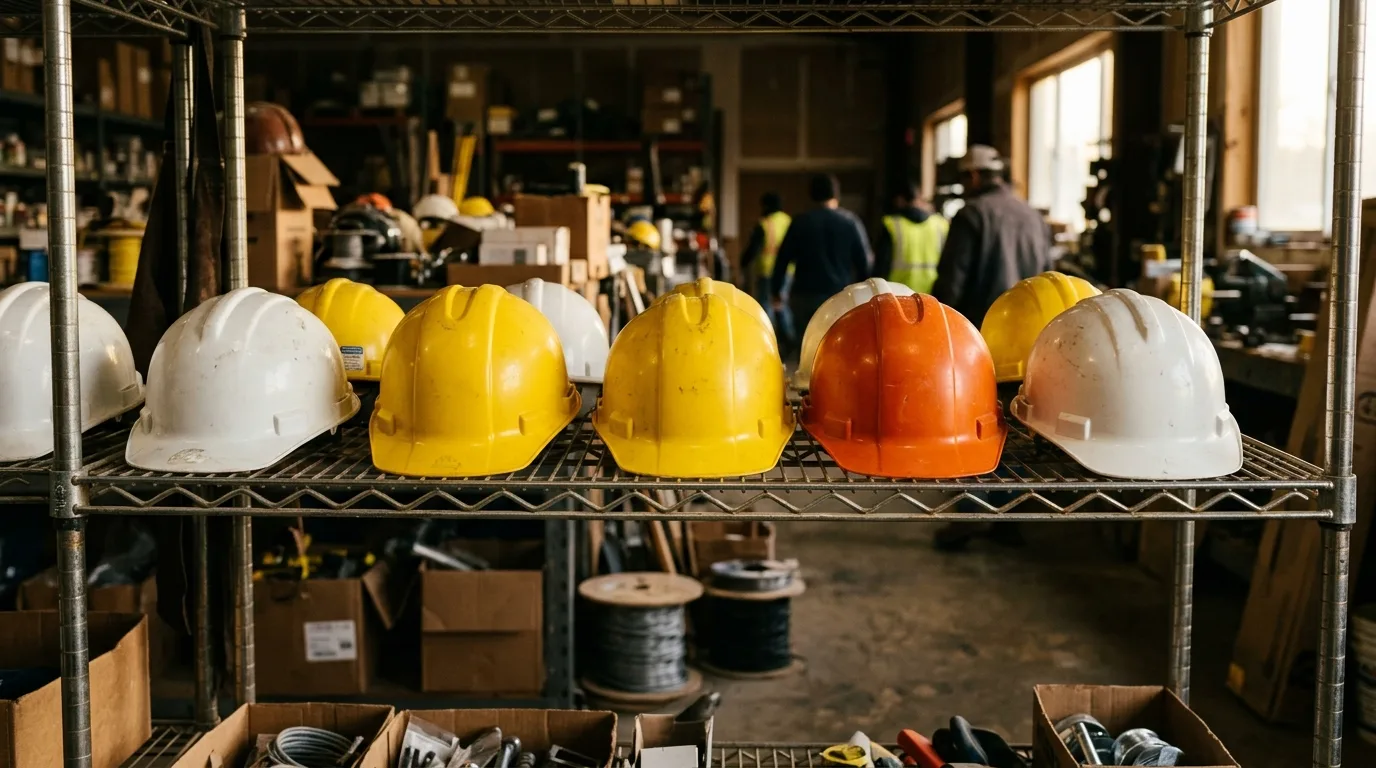
Hard hats in Staten Island are on the rack at Quazi Supply, 519 Port Richmond Avenue. We stock Type I and Type II ANSI Z89.1 hard hats — cap style and full brim — with Class C, G, and E electrical ratings, in white, yellow, orange, blue, green, red, and hi-vis lime. Brands include Kingston, Climate, and DeWalt, plus economy and ratchet-suspension options. Open 11 to 8, seven days. Custom logo printing available for crews and companies.
Hard hats are the kind of PPE most guys never think about until they actually take a hit, and at that point what matters is whether the hat was the right type for the hazard. Knowing the difference between Type I and Type II — and between Class C, G, and E — is the difference between walking off the site and going to the ER.
Type I versus Type II. ANSI Z89.1 splits hard hats by the direction of impact they protect against. Type I protects only against impact to the top of the head — falling debris, dropped tools, falling objects. This is the standard American construction hard hat and what most guys wear. Type II protects against top impact and lateral (side) impact. Type II uses internal foam padding to absorb side blows that would otherwise crack a Type I shell. If you're working in tight spaces with overhead beams (steel framing, MEP rough-in, refinery work), getting hit on the side of the head from a swinging member is more likely than getting hit straight on top. Type II is the right call there.
Class C, G, and E. These are the electrical ratings. Class C is conductive — no electrical protection at all. Useful for general construction where electrical hazards aren't a factor, often vented for ventilation. Class G is general-purpose, rated to 2,200 volts. Most American construction hats are Class G by default. Class E is electrical, rated to 20,000 volts — required for electrical workers, utility linemen, and anyone working on or near energized equipment over 600 volts. If your job specs Class E, do not buy Class G. The ratings are not interchangeable.
Cap style versus full brim. Cap style is the standard baseball-cap shape, with a forward brim. Full brim has a brim that goes all the way around. Two reasons to choose full brim: rain or sun shedding off the back of the neck (roofers, exterior crews in summer), and impact protection from objects falling at angles other than directly above. Cap style is more popular because it's lighter and works better with face shields and welding hoods. Full brim is what you wear if you spend all day outside in the weather.
Suspension types. The suspension is the harness inside the hat that keeps the shell from touching your skull. Two main types: pin-lock (cheaper, manual size adjustment by snapping pegs into holes) and ratchet (turn a dial at the back to fine-tune fit on the fly). Ratchet costs $5 to $15 more and is worth it for any hat you'll wear for more than a couple hours a day. The dial lets you loosen the hat when you sweat, tighten it when the wind picks up, and accommodate a beanie or balaclava in winter without changing settings.
"If your hat has visible cracks, gouges, or paint discoloration, replace it now — don't wait for the 5-year mark."
Color codes. Most jobsites use color to identify roles. White is typically supervisors, foremen, and engineers. Yellow is general laborers and earthmovers. Orange is road crews and visitors. Blue is electricians and carpenters. Green is safety officers or new workers. Red is firewatch or emergency. Hi-vis lime is for low-light work zones. Companies often have their own color schemes — buy what your foreman tells you to buy. We stock all the common colors.
Replacement timeline. ANSI recommends replacing the suspension every 12 months and the shell every 5 years from the date of manufacture, regardless of visible damage. Date of manufacture is stamped inside the brim — look for a small clock-face symbol with a year in the middle. Shells crack invisibly from UV exposure and impacts that didn't seem like a big deal at the time. If your hat has any visible cracks, gouges, or paint discoloration, replace it now — don't wait for the 5-year mark. We also see hats damaged by petroleum products (gasoline, hydraulic fluid) which weakens the polyethylene shell. If you've spilled fuel on your hat, get a new one.
On stickers and modifications. ANSI Z89.1 prohibits modifying the shell — drilling holes, gluing on metal accessories, painting with petroleum-based paints, or adding heavy stickers that cover more than a small portion of the shell. Light vinyl stickers (company logo, name) are generally fine and we apply them on request. Don't drill the hat to mount a flashlight bracket. Don't paint it with spray paint that contains hydrocarbons.
Hi-vis hats. We stock fluorescent lime and orange hard hats for visibility in low-light conditions. Some are factory-rated as ANSI/ISEA 107 hi-vis components, meaning the hat color counts toward your overall hi-vis classification on regulated sites. Most are not — they're just brightly colored. Check the label if your jobsite specifies an ANSI 107 hi-vis hat.
Custom printing. We can heat-press or vinyl-cut company logos, names, and project IDs onto hard hats. Single-piece minimum. Volume pricing on five or more. Same-day or next-day turnaround in most cases. We don't print on the front (where ANSI ratings are stamped) — we print on the sides and back to keep the certifications visible.
On fleet pricing: hard hats run through fleet accounts the same way vests and boots do. Net-30 terms, volume tiers, jobsite delivery. Useful for foremen replacing hats on a rolling basis as they age out or get damaged.
We're at 519 Port Richmond Avenue, Staten Island. Open 11 to 8, every day. The hard hat rack is on the right wall as you come in. Bring your old hat if you have one — easier to match the suspension type and size.