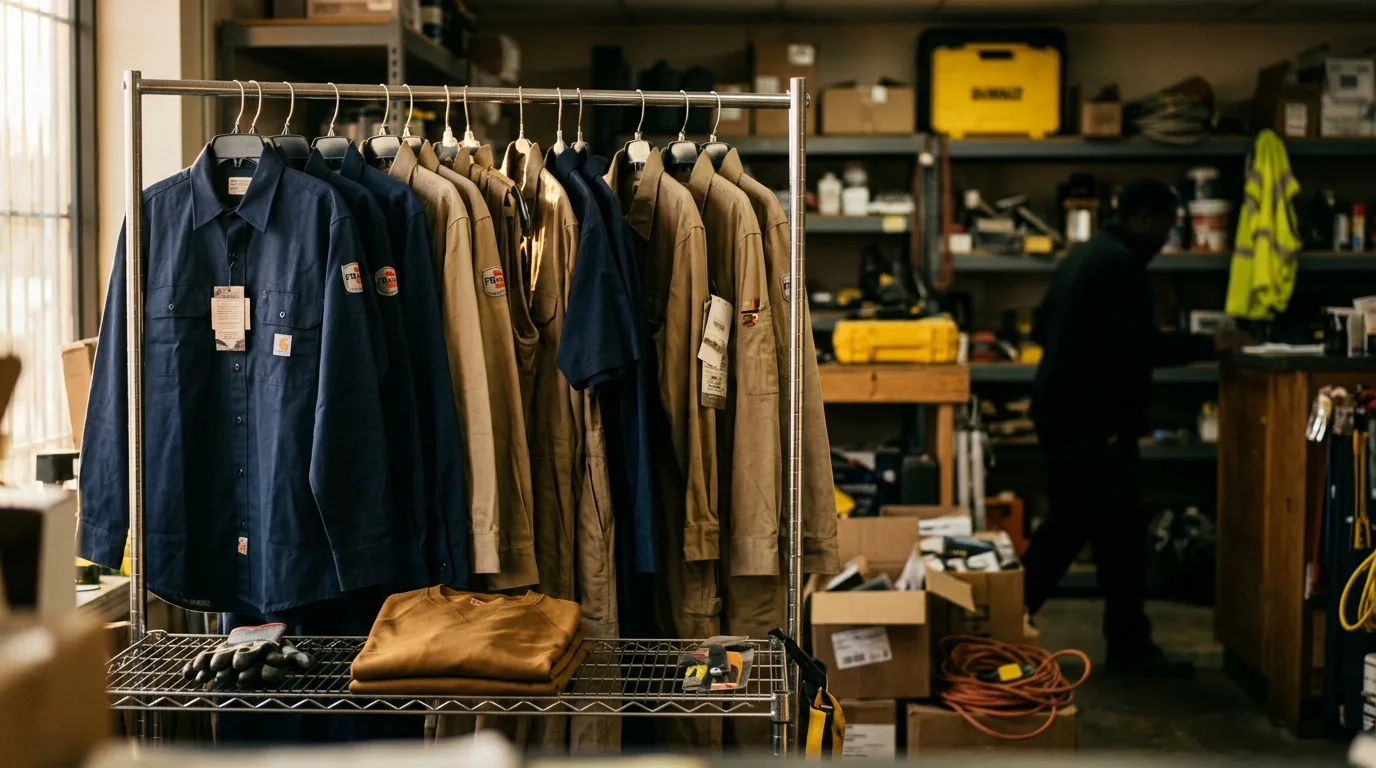
FR workwear in Staten Island is in stock at Quazi Supply, 519 Port Richmond Avenue. We carry NFPA 70E and ASTM F1506 compliant flame-resistant clothing from Carhartt FR, DeWalt FR, and Norti — shirts, pants, hoodies, jackets, and base layers — in the full size run including big and tall. Open 11 to 8, seven days a week. Welders, electricians, oil and gas adjacent contractors, and utility linemen all buy FR here.
First, what FR clothing actually does and why generic workwear isn't enough for some jobs. Flame-resistant clothing is engineered to self-extinguish when removed from the source of ignition. Cotton, polyester, and most blends will catch fire and continue burning — they melt, drip, and stick to skin, which is the cause of most arc-flash and flash-fire fatalities. FR fabric, by contrast, chars and stops burning the moment the heat source is removed. The result: the same incident that would cause third-degree burns over 60% of a body in regular clothing causes second-degree burns over 15% in FR.
The standards you need to know. NFPA 70E is the standard for electrical safety in the workplace — it dictates what FR rating an electrician needs based on the arc-flash hazard at the equipment they're working on. ASTM F1506 is the materials standard that FR garments are tested against. ATPV (Arc Thermal Performance Value) and EBT (Energy Breakopen Threshold) are the ratings that tell you how much arc-flash energy a garment can withstand before causing a second-degree burn. Higher ATPV is better. Most FR work shirts run between 8 and 12 cal/cm² ATPV. Heavier outer layers (jackets, coveralls) run 25 to 40 cal/cm². Layering FR garments stacks the protection — an 8 cal shirt under a 12 cal jacket gives you about 20 cal total.
Who needs FR. Electricians working on energized equipment, especially anything past 50 volts. Welders. Oil and gas workers. Utility linemen. Industrial maintenance crews. Refinery and chemical plant contractors. In New York City, most union electrical work above a certain amperage requires FR layers per the contractor's safety plan, and OSHA enforces NFPA 70E compliance on regulated sites.
What we stock.
Carhartt FR is the dominant line on the wall. Carhartt FR shirts (work shirts, henleys, hoodies) run ATPV ratings around 8.9 cal/cm². Carhartt FR midweight pants and jeans hit similar numbers. The duck canvas FR jacket is around 25 cal/cm² and is what most guys layer on top in winter. Carhartt FR is built like regular Carhartt — same fit, same toughness — but the fabric is engineered FR through and through, not a coating that washes out. Around $80 to $120 for a shirt, $90 to $140 for pants, $200 to $280 for the duck jacket.
DeWalt FR is the newer entry. DeWalt FR jackets, hoodies, and pullovers are competitive on price with Carhartt FR and run similar ATPV ratings. Some guys prefer the DeWalt fit — slightly more athletic, less boxy than Carhartt. We stock both and let customers compare.
Norti FR layers fill out the base-layer side. Norti FR base shirts (long-sleeve crew necks worn under outer FR) run lighter weight and are designed for layering. ATPV around 6 to 8 cal/cm² individually. Stack one under a Carhartt FR shirt and a Carhartt FR jacket and you're at 30+ cal/cm² total, which covers most arc-flash hazard categories.
On non-FR layers under FR: this is critical. Anything synthetic worn under FR — polyester long underwear, nylon, fleece — will melt under the FR layer in a flash event. The melted synthetic against your skin causes worse burns than the heat itself. The rule: if you're wearing FR outerwear, your base layer must also be FR or 100% cotton. Norti FR base layers solve this. Cotton base layers also work but provide no additional FR rating themselves.
On washing: FR garments require some care. Don't use bleach, fabric softener, or starch — they degrade the FR treatment and reduce the rating over time. Industrial laundering is fine. Home washing is fine if you skip the additives. Most FR garments are rated for 25 to 50 industrial wash cycles or 50 to 100 home washes before the FR rating starts to degrade meaningfully. Carhartt and DeWalt label the expected lifespan on the tag.
On layering math: ATPV does not stack linearly in real-world conditions, but it stacks. A 12 cal shirt under a 25 cal jacket is generally treated as 37+ cal/cm² total in NFPA 70E hazard analysis, with the actual tested rating depending on the fit and air gap between layers. Tighter fit, less protection. A loose air gap between layers traps cooler air and improves the overall protection. This is why FR shirts and jackets run a bit boxier than civilian clothing — the air gap is engineered in.
Who comes in for FR. Electrical apprentices buying their first set before starting a union program. Welders restocking shirts after burning through a set. Foremen outfitting an entire industrial crew. The application form for fleet accounts is at our fleet and crew accounts apply page — useful if you're ordering FR for a crew of ten or more on a recurring basis.
We're at 519 Port Richmond Avenue, Staten Island. Open 11 to 8, every day. The FR rack is in the middle of the store. Bring the spec sheet from your foreman if you have one — we'll match the ATPV rating to the right garment in five minutes.