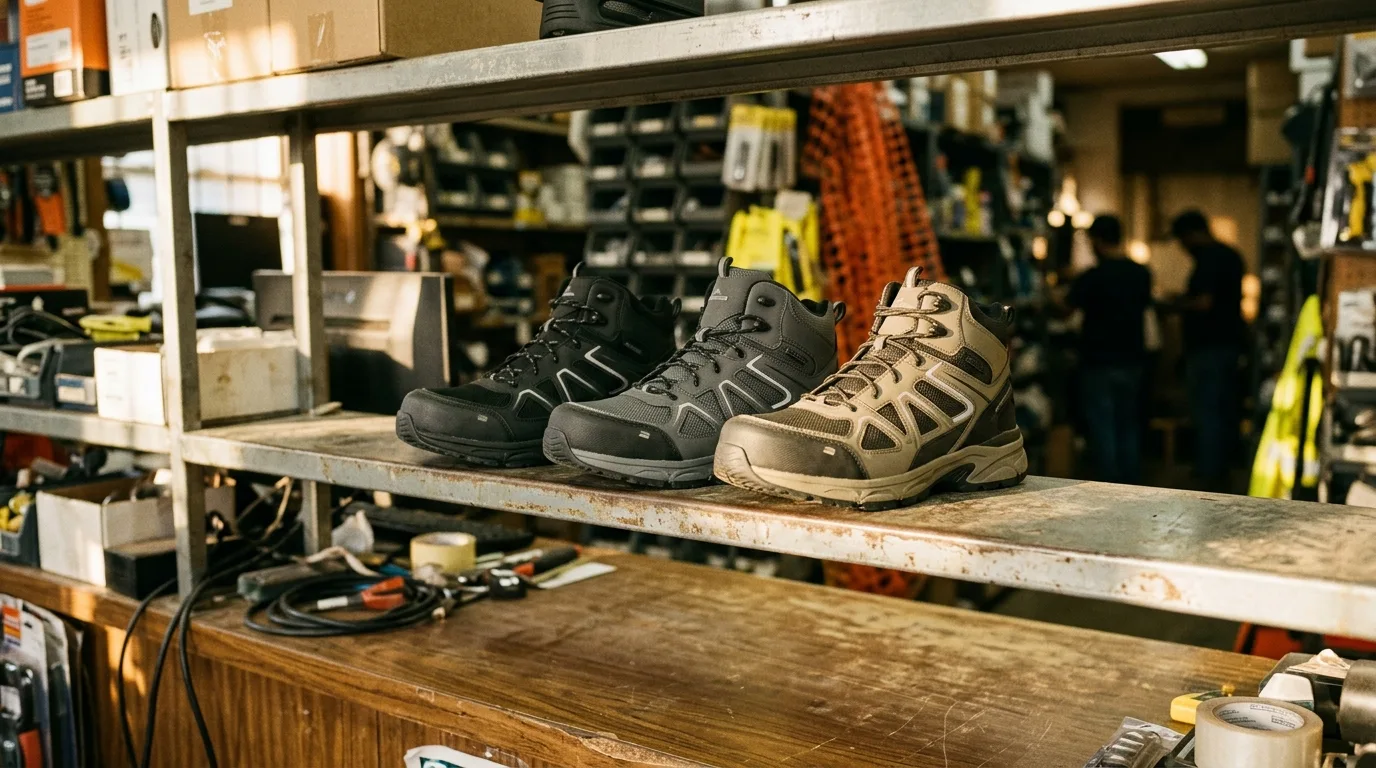
Composite-toe boots in Staten Island are on the wall at Quazi Supply, 519 Port Richmond Avenue. We carry composite-toe builds from Timberland Pro Boondock, Rockrooster, Eurbak, Thorogood, and Wolverine — full ASTM F2413 ratings, same protection as steel, lighter weight, no thermal or electrical conductivity. Open 11 to 8, seven days. Try them on with the right socks, walk out wearing them.
First, the misunderstanding to clear up. Composite toe is not plastic. Composite is a layered construction — usually fiberglass, Kevlar, carbon fiber, and high-density plastic resin combined under heat and pressure. The result is a toe cap that meets the same ASTM F2413 standard as steel: 75-pound impact dropped from 18 inches, 2,500-pound static compression. The protection is identical on paper. The difference is what the material does outside of impact.
Three reasons trades choose composite over steel.
Reason one: weight. A composite toe runs roughly 4 to 8 ounces lighter per boot than steel. If you're climbing scaffolding, walking sites for ten hours, or going up and down ladders all day, that's noticeable by week two. The guys who care most about this are framers on multi-story projects, electricians running cable through high-rises, and HVAC techs who do rooftop work.
Reason two: thermal conductivity. Steel transfers cold and heat fast. In a Northeast winter on an outdoor jobsite, steel-toe boots get cold and your toes feel it through any sock thinner than wool. Composite doesn't conduct temperature the same way — it stays at body temperature longer. Same goes for hot environments: roofers, asphalt crews, and guys working near heat sources prefer composite because the toe cap doesn't bake.
Reason three: metal detection and electrical work. If your jobsite has metal detectors at the entrance — federal buildings, airport projects, secure infrastructure — steel toes set them off every time. Composite walks through clean. For electricians, composite toes paired with an ASTM F2413 EH (electrical hazard) rating means the boot won't conduct current to your foot if you contact a live wire. Steel toes can be EH rated too, but composite is the safer default and most electrical apprenticeship programs recommend it.
On the wall, here's what we stock and who buys what.
Timberland Pro Boondock composite-toe waterproof is our top seller. Around $230. The 8-inch height supports the ankle on uneven ground. Anti-fatigue midsole, real waterproof membrane, and the composite toe shaves about a half-pound off the steel version. Goes to electricians, HVAC, and framers.
Rockrooster composite-toe builds run $130 to $180. The lightest boots on the wall by a meaningful margin — some models come in under 2 pounds per boot, which sounds small until you've worn 3.5-pound steel-toe boots for a year. Kevlar puncture plate in the sole is standard on most Rockrooster composite models, which matters for demolition and renovation work where nails and screws are everywhere underfoot.
Eurbak is the European-styled composite line we stock. Narrower last, slimmer profile, and the boots look less like "work boots" — some of our customers are HVAC techs, IT field guys, and inspectors who walk client homes and want a boot that doesn't look like it just came off a job. ASTM F2413 rated, composite toe, same protection in a cleaner shape. Around $150 to $200.
Thorogood Infinity FD composite is the American-made option in this category. Around $250. Soft polyurethane midsole, Goodyear welt construction so the boot is resoleable, and the composite toe sits in a roomier toe box than the Boondock — useful if you have a wider foot or hammertoe issues.
Wolverine offers composite-toe versions of the Floorhand and Overpass for guys who want to stay in the Wolverine line. Waterproof, ASTM rated, around $180.
On the question of "is composite as strong as steel" — at the F2413 standard, yes, identically. Past the standard, steel can absorb more energy in extreme drops because steel deforms predictably and composite tends to crack. But "past the standard" means dropping more than 75 pounds from more than 18 inches, which is rare in normal construction work. If you're working in a foundry, a heavy steel mill, or somewhere with extreme overhead drop hazards, steel might still be the right call. For 95% of construction trades, composite is more than enough.
Sizing for composite toes runs slightly different than steel. The toe box on most composite builds is a touch roomier because the material can be molded to a wider shape than steel. If you've worn a 10.5 wide in Timberland Pro steel toe, you might find the composite version fits better in a 10 wide. Try them on. We have the Brannock on the floor.
We're at 519 Port Richmond Avenue, Staten Island. Open 11 to 8, every day. The boot wall is in the back. If you're outfitting a crew and want composite-toe boots in volume, ask about fleet pricing — five or more pairs gets a discount and we deliver to the jobsite.